
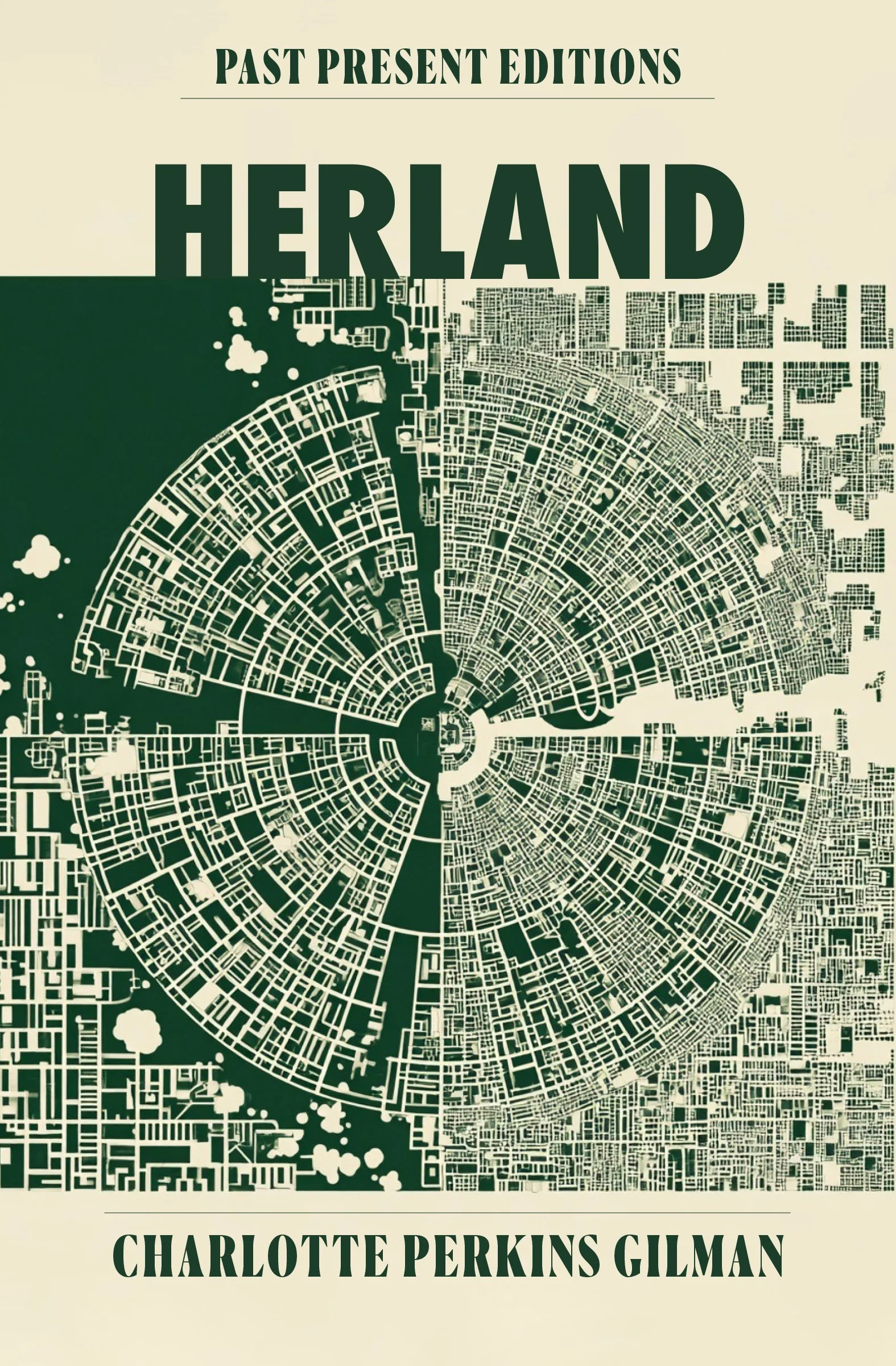
Herland never had a traditional first edition. It appeared in monthly installments throughout 1915 in Gilman's self-published magazine The Forerunner—read by fifteen hundred subscribers and then lost to history for sixty years.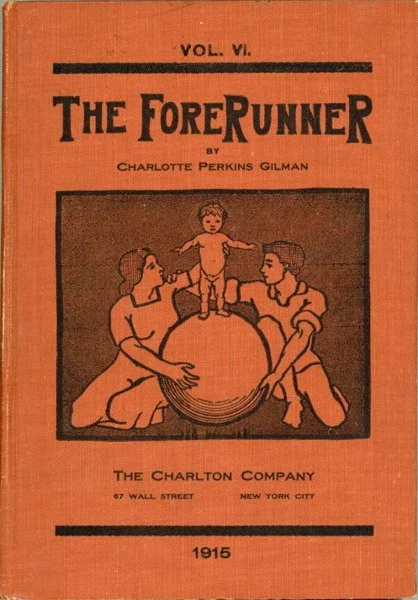
Herland
by Charlotte Perkins Gilman
The Country That Had No Use For Men
In 1915 Charlotte Perkins Gilman published Herland. She was fifty-five years old, and had already written The Yellow Wallpaper, the short story that has immortalized her and made her a staple in English Lit classes around the world. She had also already published Women and Economics, the feminist theoretical work that made her internationally famous and briefly placed her alongside Susan B. Anthony and Elizabeth Cady Stanton as one of the most consequential women in American public life. In her tumultuous personal life, she had also survived a first marriage, a nervous breakdown, the loss of custody of her daughter, and a level of public vilification that would have silenced most people permanently.
Thankfully Gilman was not most people.
She published Herland not in a mainstream literary journal or with a commercial publisher but in her own monthly magazine, The Forerunner, which she wrote almost entirely by herself for seven consecutive years between 1909 and 1916. Herland appeared in serial installments throughout 1915, one chapter per month, in a magazine with a circulation of roughly fifteen hundred subscribers. It was read, appreciated by those fifteen hundred people, and then effectively vanished for sixty years.
What those fifteen hundred people read was unlike anything else being published in 1915.
In the stories, three American men—a sociologist, a naturalist, and a soldier, representing between them the intellectual, scientific, and martial pillars of early twentieth century masculinity—discover a hidden country populated entirely by women. There are no men. There have been no men for two thousand years. The country, which the men name Herland, is orderly, abundant, rational, peaceful, and quietly devastating to every assumption the three explorers brought with them. Gilman gives the men enough genuine intelligence and self-awareness to slowly recognize what they're seeing, and enough ingrained patriarchal assumption to resist recognizing it until they can't anymore. The comedy is dry and precise. The argument is total.
What Gilman was doing, and what makes Herland more sophisticated than a simple utopian fantasy, is using the thought experiment not to describe a perfect world but to expose the architecture of an imperfect one. Every time one of the men explains to the women of Herland how things work in the outside world—how competition drives progress, how women need protection, how motherhood is fulfillment enough—the women listen with genuine curiosity and ask questions that dismantle the explanation entirely. They are not hostile. They are simply logical. And logic, applied with sufficient patience to the structure of early twentieth century gender relations, turns out to be a remarkably effective demolition tool.
Gilman, who had been doing the demolition work for thirty years, was tired of being subtle.
Gilman's personal life was as radical as her fiction and considerably more controversial in her own time. After leaving her first husband—the painter Charles Walter Stetson, whose insistence that she fulfill a conventional domestic role contributed directly to the nervous breakdown she later fictionalized in The Yellow Wallpaper—she made the extraordinary decision to send her daughter to live with her ex-husband and his new wife, who happened to be Gilman's closest friend. The public condemnation was immediate and ferocious. Newspapers called her an unnatural mother. She called it the most rational decision available given the circumstances. She was probably right, and the fact that she had to make it at all is the argument Herland is making on every page.
Herland was rediscovered in 1979 by the feminist scholar Ann J. Lane, who edited and published the first modern edition sixty-four years after its original serialization. The timing was not accidental. The women's movement of the 1970s created an audience that 1915 didn't have and couldn't have imagined. Gilman had written for readers who didn't exist yet, in a magazine she published herself, in installments of a novel she never saw properly bound in her lifetime.
Gilman died in 1935, having chosen her own death. She was diagnosed with breast cancer and ended her life with chloroform, leaving a note explaining that she preferred a quick death to a slow and useless one. The note was characteristically clear, rational, and pure Gilman, who had spent her entire life arguing that women deserved the right to make their own decisions.